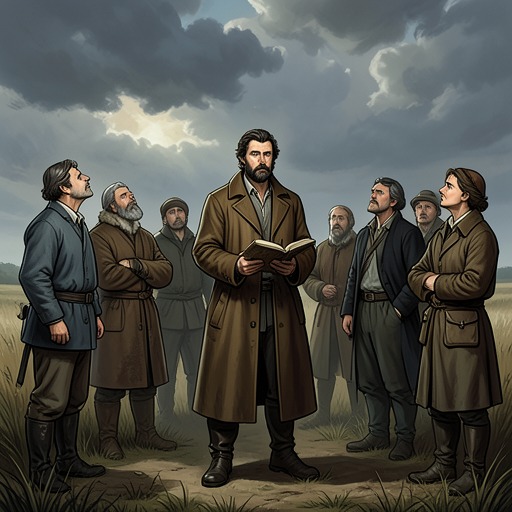
Wilford Woodruff
Under the Banner of HeavenWilford Woodruff was the fourth prophet of the Church of Jesus Christ of Latter-day Saints and the leader who announced in 1890 that the church would no longer sanction plural marriage. His decisive act came as federal pressure threatened the church’s institutional survival, placing him at the hinge between a doctrine leaders had defended as divinely ordained and a public commitment to obey federal law.
A church under pressure
Woodruff’s place in the history of plural marriage was shaped by a conflict that had been building for decades. In 1856, while serving as an apostle, he observed that men were seeking wives so rapidly that scarcely any girl in Utah aged fourteen or older remained unmarried or was not about to marry. The observation registered how deeply the practice had entered community life; it also anticipated the widening divide between the Saints’ religious commitments and the judgment of the wider republic.
By the late 1880s, that conflict had become an immediate institutional crisis. After John Taylor died in 1887, Woodruff, then eighty-two, was installed as the church’s fourth prophet. Federal resistance had intensified: Congress passed the Edmunds-Tucker Act in 1887, and in May 1890 the U.S. Supreme Court ruled that church holdings could be seized by the government. The account presents the church as nearing collapse, with its property and continued ability to function at stake. Woodruff’s decision therefore concerned not only a religious teaching but the terms on which the church might continue to exist under federal authority.
The decision of September 1890
On the evening of September 23, 1890, Woodruff went to bed and, as he later reported, struggled through the night with the Lord over what should be done in the circumstances facing the church. In the morning, he called five trusted church leaders together. He told them, with a broken spirit, that revelation had made clear the necessity of giving up the practice for which church members had been willing to lay down their lives. He said it was the Lord’s will that the church stop sanctioning plural marriage. The other men in the room were shocked and horrified by the announcement.
The episode placed prophetic authority at the center of a painful reversal. The practice had been presented to the Saints as a divinely ordained doctrine, and its defenders had treated it as worth enduring severe conflict. Now Woodruff invoked divine direction to justify retreat. Rather than describe the change as a voluntary loss of belief in the principle, the book emphasizes the pressure of circumstances and Woodruff’s claim that revelation required a new course. His authority as prophet gave the decision religious force even as it altered the church’s official position.
The Manifesto
On October 6, 1890, Woodruff formalized the change in a brief public document known as the Manifesto, or the Woodruff Manifesto. It declared his intention to submit to congressional laws against plural marriages, which the highest court had found constitutional, and to use his influence to encourage church members to do likewise. It also advised Latter-day Saints to refrain from contracting any marriage forbidden by the law of the land.
The Manifesto’s wording is significant for its stated scope. It addressed marriages prohibited by law and declared the church’s intention to comply; it did not, in the passages presented, set out a detailed account of how every existing marriage or household would change. The book frames the document as an official surrender of church sanction for plural marriage, issued when federal action had made continued defiance increasingly costly. Woodruff signed it as president of the Church of Jesus Christ of Latter-day Saints, transforming a reported private revelation into a public institutional declaration.
Prophetic authority and historical consequence
The decision also sits within a broader tension in Mormonism between personal revelation and centralized authority. Joseph Smith had encouraged Latter-day Saints to seek direct impressions from the Lord, but in 1830 he announced that no one else was to receive commandments and revelations for the church. The continuing appeal of personal revelation helped produce competing claims to religious authority and, over time, schismatic groups. Woodruff’s Manifesto represents a different use of revelation: a prophet’s claimed divine instruction settled an institutional question and directed the conduct of the church’s members.
The account’s treatment of Woodruff is therefore concentrated on a specific act of leadership rather than a broad personal portrait. His role connects the fervent expansion of plural marriage in the 1850s to the church’s official retreat from sanctioning it in 1890. The contrast is especially sharp: in 1856 he recorded the speed with which men were marrying, while in 1890 he announced that members should refrain from marriages forbidden by law. The Manifesto did not erase the doctrine’s history or the conflicts surrounding it; it marked a consequential change in how the institution would publicly respond to federal power.